Schools & districts · dyslexia and reading difficulties · K–6

Some readers stall even with strong instruction. There’s a layer underneath.

A rhythm-based intervention that trains the sound-processing skills reading is built on. In a randomized trial, adding Poppins Learning to in-person reading support produced more progress in 12 weeks.

Covered by France’s national health systemThe French equivalent of the FDA, a bar no other reading app has cleared
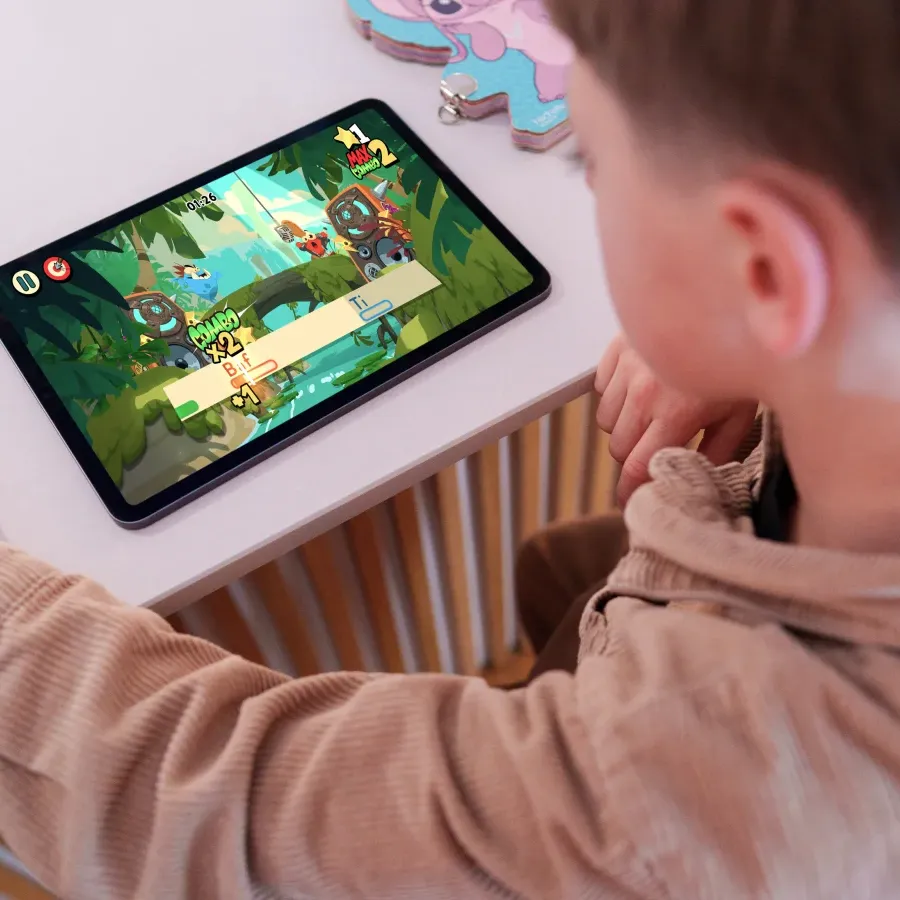
A student at a desk working through a Poppins Learning reading session on a tablet.
Students use it independently
20 minutes, 3×/week

Reading isn’t just letters. It’s processing.

Structured literacy teaches all of reading, and for most students it works. For many students with dyslexia it isn’t enough on its own, and not because the instruction was wrong. Research points to a layer underneath it: the phonological processing and sequencing the brain uses to turn letters into words at speed.

Poppins Learning trains that layer. That’s how it can speed up the intervention you already run.

ABOVE THE SURFACE: WHAT YOUR INSTRUCTION ALREADY COVERS
The instruction layer

Phonemic awareness, phonics, fluency, vocabulary, comprehension, delivered by your interventionists. That’s the core of strong reading instruction, and Poppins Learning is built to accelerate it.

BELOW THE SURFACE: RARELY TARGETED
The processing layer underneath itthe layer underneath

Students complete short practice sessions that use rhythm and multisensory exercises to improve underlying skills. Poppins Learning has been tested in two randomized clinical trials, both showing gains in reading fluency.

Poppins Learning daily + reading support every other weekWeekly reading support alone
Average progression · words read correctly in 2 minutes (EVAL2M test)
0
2
4
6
8
10
12
+8.6
+3.9
+4.67adjusted differencep = 0.008
+4.67adjusted difference · p = 0.008
n = 154n = 152
Reading fluencyRandomized trial · 306 children · 12 weeksEVAL2M is a French reading-fluency test, so the word counts don’t translate directly to U.S. norms.about twice the progress when added to every-other-week sessions

We tested it alongside real reading support.

In a randomized trial of 306 children with dyslexia, students who added Poppins Learning to every-other-week reading support made 2.2× the reading-fluency progress of students on weekly support alone. That’s about twice the progress in the same 12 weeks.

Poppins Learning can accelerate reading intervention, but does not replace it. The results are final but not yet published. The trial ran in France using a French reading test, so the raw scores don’t translate to U.S. norms. The comparison does.

A separate, earlier trial, peer-reviewed and published in Scientific Reports, a Nature Portfolio journal, 2025, tested Poppins Learning against a control game and found gains in reading fluency and speed.
See the full science →

What the research found.

the typical effect size in education researchPoppins Learning scored d = 0.31, measured against active weekly reading support rather than against no support at all. The median across education trials is d = 0.10 (Kraft, 2020).
≈ 4–5
extra months of reading growth, in the same 12 weeksbeyond what weekly reading support alone delivered
12
weeks to measurable resultsPoppins Learning added to every-other-week in-person reading support, over a single 12-week trial

The school-time figure is an interpretive translation of d = 0.31 (Bloom et al. 2008; Lipsey et al. 2012, U.S. norms): a guide, not a guarantee, and conservative for children with dyslexia. The results are final but not yet published.

One program, the whole pathway.

Most states now screen for dyslexia risk in the early grades. What follows is a sequence of reviews and decisions, and a student can wait at any step. Poppins Learning is supplemental practice, so it can start at the first flag and keep running as the support around it changes.

01Universal screeningEarly-grades screeners flag students showing dyslexia risk factors. Finishing the dyslexia screener takes a reading specialist to administer the last tasks one on one.
02Results reviewedThe school team weighs the screener against other indicators and notifies families. The student is often still receiving core instruction only.
03Tiered supportClassroom support first, then targeted small-group support in Tier 2, with progress monitored on a set schedule.
04Further assessmentIf progress stays minimal, a fuller reading assessment, a student support team meeting, and an evaluation if the team decides one is warranted.
05Special educationIf the student qualifies, an IEP sets the services they receive.
Poppins Learning can run at any point along this path

Pathways vary by state and district. This is the common shape, not any one district’s process.

Built for busy reading and resource specialists looking for efficient results.

01 · IndependentStudents use it independentlyYou get students set up, then they work through each session on their own, one student per headset.
02 · AdaptiveMeets every reader where they areRhythm and reading exercises adapt in real time. Your strongest and most struggling readers can sit at the same table, each working in their own zone.
03 · Fits the blockSlots into the block you already runSessions are short and self-contained, so they fit whatever block a student is already scheduled into instead of asking for a new one.
Rosters via Clever, ClassLink & Google · signable DPA · FERPA & COPPA-ready

Every student flagged for dyslexia should be getting support. Every interventionist knows how hard that is to actually deliver.

Poppins Learning gives students structured practice they can do themselves, working the processing skills underneath their reading.

What it isn’t
Another dashboard to babysit
One more password for students to lose
A replacement for your interventionists
A game reskinned to look educational
If it adds work to a teacher’s plate, it doesn’t survive our design review.
What it is
An adaptive literacy sequence students can work through independently, at their own desk, in a group, or at home
20 minutes, 3× a week, inside a block you already run
A fit at every stage: after a screener flag, through MTSS Tier 2 and Tier 3, and on an IEP
Practice students engage with rather than resist

The credentials behind the program.

Peer-reviewed research and coverage by a national health system. That’s the kind of proof all interventions should have.

Peer-reviewed & publishedFirst randomized trial published in Scientific Reports, a Nature Portfolio journal, 2025.
Children's Hospital LADigital Health Award from their Innovation Studio.
Covered in FranceReviewed and covered by the national health system, the French equivalent of the FDA.
Built with neuroscientistsA rhythm-based layer on top of structured literacy, aligned with the science of reading.
Funding

Most schools fund Poppins Learning with dollars they already have.

Title I, IDEA, and state literacy funds all apply. Our published randomized trial supports an evidence-based-intervention rationale, and we’ll walk your team through the pathway for your state and building.

See the funding guide →
Common pathways
Title IFederal
IDEAFederal
Literacy fundsState

Educators often ask

01Which students is Poppins Learning for?Grades K–6 students who need more than core instruction. That includes students a state screener has just flagged for dyslexia risk, students still in Tier 1 while the team reviews them, students in MTSS Tier 2 and Tier 3, and students already on an IEP in special education. It’s supplemental practice rather than a core curriculum, so it works at any of those stages and a student doesn’t have to switch programs as their support changes.
02How much teacher time does it really take?You get students set up once, and from there each session runs itself: students start and finish on their own, so you are not delivering the lesson. Plan for the initial setup and for checking in on students, not for running each session.
03Data privacy, rostering, devices?Signable data privacy agreement; FERPA, COPPA, and state student-privacy laws covered. Rostering and SSO via Clever, ClassLink, and Google. Poppins Learning installs from the App Store or Google Play and runs on tablets and phones, iOS and Android; on Chromebooks or another centrally managed fleet, the install is planned with your IT team ahead of launch rather than pushed as a standard install. Every student needs their own headset, headphones with a working microphone, because the listening tasks do not work over a device speaker in a shared room and some activities capture a short voice sample.
04Do you have anything written for the teacher who runs the block?Yes. Our teacher guide is the longer reference a teacher keeps: what happens in the first session, what an adult does while a session runs, the headsets and devices every student needs, how the practice fits into a week, and what a teacher can and cannot change inside the app.
05Does Poppins Learning meet ESSA evidence requirements?A formal ESSA evidence review is on our roadmap for the coming months. In the meantime, your team can evaluate the evidence directly: one randomized controlled trial published in a peer-reviewed journal, and a second, larger randomized trial with final results. Together they support the evidence-based-intervention rationale most funding applications ask for. We hand over the documentation and walk through it with your curriculum lead, under your state’s guidance.
06What does it cost?It depends on your seat count and rollout. We’ll give you exact figures on the first call, so you can plan your budget before you commit to anything.

Let's bring Poppins Learning to your students.

We’re looking for schools to run Poppins Learning with 10 or more students this school year, starting with a free 12-week pilot. Book a 30-minute call to see whether your school is a fit.

Book a timePrefer to send details first? Use the form.
1Pick a time on our calendar, for whoever you want in the room.
2A 30-minute walkthrough: the product, the evidence, and what a pilot involves.
3A pilot plan mapped to your students, your schedule, and your devices.
Replies within one school day
Tell us about your school
By submitting this form you agree to receive marketing communications from Poppins Learning. You can unsubscribe at any time using the link in any email.
Supplemental reading intervention, K–6Talk to our team